
Let’s be honest about what is happening inside most enterprises right now.
The business units are moving fast. The marketing team has a GenAI tool. Finance is piloting a forecasting model. Operations wants to automate decision workflows. And somewhere in the middle of all of this, the CIO is fielding ten different AI requests a week each one promising transformation, none of them talking to each other.
This is the reality of enterprise AI in 2026. Not the polished keynote version. The messy, ungoverned, departmentally fragmented version that most technology leaders are actually living.
The biggest challenge technology leaders are preparing for is scaling AI enterprise wide without losing control. AI requests flood in from every department. Without proper governance, organizations risk conflicting data pipelines, inconsistent architectures, and compliance gaps that undermine the entire tech stack.
That last line deserves to sit with you for a moment. Not because it is alarming but because it is entirely preventable.
The Pilot Trap: Why Speed Without Structure Always Fails
There is a seductive logic to moving fast with AI. Pilots are cheap. Results look impressive in a deck. Stakeholders get excited. And so organizations launch project after project, each one independent, each one governed by a different set of assumptions about data, security, and acceptable model behavior.
Then the pilots end. And the question of production begins.
If 2025 was the year of proving AI’s potential, 2026 is the year of putting it to work. Generative AI is embedded in the way businesses operate. But three out of four organizations admit their governance hasn’t kept pace with AI adoption and 97% of IT decision makers report challenges when implementing new AI initiatives, with governance, security, and systems integration being the top challenge to deployment.
Read that again. Ninety seven percent. That is not a minority of enterprises struggling with governance. That is almost every enterprise including yours.
The problem is not the AI itself. The models are capable. The problem is the organizational infrastructure around the AI. The policies that define what is acceptable. The data frameworks that ensure the inputs are trustworthy. The oversight mechanisms that catch a model behaving in ways no one anticipated.
Without that infrastructure, you are not scaling AI. You are scaling risk.
What “Governance” Actually Means in Practice
When most technology leaders hear “AI governance,” they think of compliance checklists and regulatory frameworks. Important, yes but that is only one layer of what governance actually requires at enterprise scale.
Real AI governance in 2026 covers six critical dimensions:
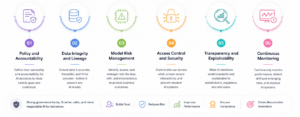
- 1. Policy and Accountability
Who owns the decision when an AI model produces a wrong output that affects a customer, a trade, a medical recommendation, or a hiring decision? If the answer is “we’re not sure,” you do not have governance. You have a liability gap. - 2. Data Integrity and Lineage
An AI model is only as trustworthy as the data it was trained on and the data it operates against in production. Governance means knowing where that data came from, who touched it, and whether it was fit for purpose before the model ever sees it. - 3. Model Risk Management
Every AI model carries risk. Not just the obvious risks of bias or hallucination, but the operational risks of drift, version inconsistency, and the downstream impact of model decisions on business outcomes. A governed enterprise tracks these risks the same way it tracks financial or operational risk. - 4. Access Control and Security
When controls arrive late, enterprises end up with shadow systems, blanket bans, and audit panic. When governance is built upfront, AI becomes repeatable and defensible. Access governance means defining, at a granular level, who can query what, what data an AI system can surface, and what actions it can take autonomously versus when it must escalate. - 5. Transparency and Explainability
Can your team explain to a regulator or to your board why the AI made a specific decision? In regulated industries, this is not optional. In every industry, it is becoming an expectation. - 6. Continuous Monitoring
Governance is not a one time event at model deployment. It is a continuous process of monitoring for drift, unexpected behavior, and emerging risk. The enterprises that get this right build it into their MLOps and data platform infrastructure from day one.
The Cost of Getting the Order Wrong
Here is what happens when enterprises decide to scale first and govern later.
CIOs are increasingly expected to align technology with business priorities, manage risk, and turn AI ambition into business results. AI adoption is only part of the challenge. The harder question is whether organizations can build the structure to sustain it.
The enterprises that skip governance at the foundation typically face one of three outcomes and often all three simultaneously.
The first is regulatory exposure. AI regulations are tightening globally. The EU AI Act is now in enforcement. Data protection frameworks in the UAE, India, UK, and Australia are evolving rapidly. An enterprise that has deployed AI without a governance framework is not just behind it is potentially non compliant with requirements it did not even know existed when it launched its first pilot.
The second is shadow AI proliferation. When centralized governance is absent or too slow, business units build around it. Teams use consumer grade AI tools on enterprise data. Decisions get made by models that no one in IT has reviewed. The organization ends up with dozens of ungoverned AI touchpoints, each a potential failure point.
The third is trust erosion. One high profile AI failure a discriminatory model output, a hallucinated customer response, a data breach traced back to an ungoverned LLM can set an enterprise’s AI program back by years. The reputational and financial cost of that single incident almost always dwarfs the investment required to have governed properly in the first place.
Building Governance That Enables, Not Throttles
The strongest objection to AI governance and it is a legitimate one is that it slows things down. That governance becomes the bottleneck that frustrates business teams and drives them toward the shadow AI behavior you were trying to prevent.
The central AI center of excellence should serve as the hub for strategy, enablement, and governance rather than as a gatekeeper for approvals. It provides infrastructure, reusable assets, training, and guardrails while business units take ownership of delivery.
This is the design principle that separates governance frameworks that work from governance frameworks that fail. Governance should not be a tollgate. It should be a set of standards, templates, and guardrails that make it faster and safer for every part of the business to build and deploy AI responsibly.
Practically, this means building the following before you scale:
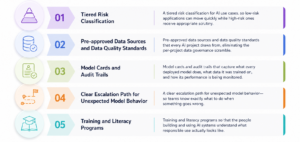
- A tiered risk classification for AI use cases, so low risk applications can move quickly while high risk ones receive appropriate scrutiny
- Pre approved data sources and data quality standards that every AI project draws from, eliminating the per project data governance scramble
- Model cards and audit trails that capture what every deployed model does, what data it was trained on, and how its performance is being monitored
- A clear escalation path for unexpected model behavior so teams know exactly what to do when something goes wrong
- Training and literacy programs so that the people building and using AI systems understand what responsible use actually looks like
The key is building governance that encourages experimentation rather than bottlenecking it. When governance is designed with that principle at its core, it becomes a competitive advantage not an obstacle.
The Window Is Narrowing
Here is the uncomfortable truth that most enterprise AI roadmaps are not acknowledging.
AI scale without governance creates risk. AI scale with governance creates advantage.
The enterprises that build governance infrastructure now before they scale will spend the next three years compounding returns. They will deploy AI faster because they will not be rebuilding ungoverned systems. They will face fewer regulatory interventions because they will already be compliant. They will attract better AI talent because governed, structured AI environments are more professionally rewarding to work in.
The enterprises that skip governance will spend the next three years dealing with the consequences of the shortcuts they took today.
The technology is not the hard part. The hard part is the organizational discipline to build the right foundation before the pressure to move fast becomes overwhelming.
That window, right now, is still open. The question is whether your organization will use it.
Conclusion: Governance Is Not the Brake It Is the Engine
There is a persistent myth in enterprise technology that governance and speed are opposites. That building a compliance and oversight framework means slowing everything down while competitors race ahead.
That myth has cost organizations millions of dollars in rework, regulatory fines, and failed AI programs.
The most advanced enterprise AI programs in 2026 the ones genuinely compounding value, quarter after quarter all share one thing in common. They built their governance infrastructure before they needed it. Not after the first model failure. Not after the first regulatory inquiry. Before.
They treated governance not as a constraint on AI ambition, but as the structural foundation that makes AI ambition sustainable.
The practical reality is this: ungoverned AI eventually stops. It gets blocked by regulators, pulled back after an incident, or quietly shelved because no one trusts the outputs anymore. Governed AI, on the other hand, keeps moving because it has earned the internal trust, the regulatory confidence, and the data quality foundation it needs to operate at scale, indefinitely.
The question for every CIO, CDO, and CTO reading this is not whether to govern your AI. That decision has already been made for you by regulators, by your board, and by the market. The question is whether you will build governance proactively on your terms and your timeline or reactively, under pressure, after something has already gone wrong.
Build the foundation first. Scale with confidence. That is the only AI strategy that holds up over time.
Great content! Keep up the good work!