
Introduction
For the last few years, enterprise conversations around artificial intelligence have largely focused on innovation, productivity, and competitive advantage. Organizations rushed to adopt generative AI, automate workflows, improve customer experiences, and unlock new revenue streams.
In 2026, however, the conversation has shifted.
Today, business leaders are no longer asking only, “How can AI help us grow?” They are increasingly asking, “How can we use AI responsibly, securely, and in compliance with emerging regulations?”
The reason is simple: governments and regulatory bodies worldwide are moving quickly to establish rules for AI development, deployment, governance, and accountability. What was once considered a technology initiative has now become a boardroom-level business and compliance priority.
From the European Union’s AI Act to evolving governance frameworks in the United States, Asia-Pacific, and the Middle East, enterprises are entering a new era where regulatory readiness is becoming just as important as technical readiness.
Organizations that adapt early will gain trust, reduce risk, and scale AI confidently. Those that ignore the regulatory landscape may face compliance challenges, reputational damage, and costly operational setbacks.
Why AI Regulation Matters More Than Ever
The rapid adoption of AI has created enormous opportunities, but it has also introduced new concerns around privacy, transparency, bias, security, intellectual property, and accountability.
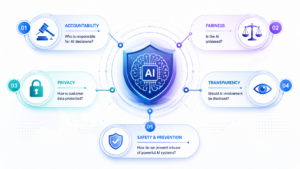
Regulators are responding to questions such as:
- Who is responsible when an AI system makes a harmful decision?
- How can organizations prove their AI systems are fair and unbiased?
- What happens when AI processes sensitive customer data?
- Should businesses disclose when AI is involved in decision-making?
- How can governments prevent misuse of powerful generative AI systems?
These concerns are no longer theoretical.
As AI becomes embedded into hiring, healthcare, banking, insurance, customer service, and public services, regulators want stronger safeguards to ensure organizations deploy AI responsibly.
For enterprise leaders, this means compliance can no longer be treated as an afterthought. It must be built into AI strategy from day one.
The EU AI Act Is Setting the Global Standard
One of the most significant developments shaping enterprise AI strategy is the EU AI Act.
Widely regarded as the world’s first comprehensive AI regulation framework, the legislation classifies AI systems according to risk levels and introduces specific obligations for organizations using high-risk AI applications.
The framework focuses on areas such as:

- Transparency requirements
- Risk management processes
- Human oversight mechanisms
- Data governance standards
- Documentation and auditability
- AI system monitoring
Although the regulation originates in Europe, its impact extends far beyond EU borders.
Just as GDPR influenced global privacy practices, many experts expect the EU AI Act to influence AI governance strategies worldwide. Organizations serving European customers or operating internationally are already evaluating how the regulation affects their AI initiatives.
For many enterprises, compliance planning has become a strategic necessity rather than a future consideration.
AI Governance Is Becoming a Competitive Advantage
Many organizations still view compliance as a cost center.
The most forward-thinking enterprises see it differently.
Strong AI governance is increasingly becoming a competitive differentiator.
Customers are becoming more aware of how their data is collected and used. Investors are paying closer attention to responsible AI practices. Partners and vendors are being evaluated on their governance maturity.
Organizations that can demonstrate transparency, accountability, and ethical AI usage are earning higher levels of trust from stakeholders.
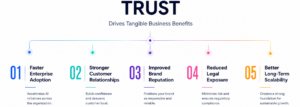
This trust often translates into tangible business benefits:
- Faster enterprise adoption
- Stronger customer relationships
- Improved brand reputation
- Reduced legal exposure
- Better long-term scalability
In many industries, trust is becoming one of the most valuable assets an organization can build.
How Enterprise AI Strategies Are Changing in 2026
Regulatory pressure is causing organizations to rethink how AI initiatives are planned, governed, and scaled.
Several major shifts are already emerging.
1. AI Governance Is Moving to the Executive Level
AI decisions are no longer owned exclusively by IT or data science teams.
Today, CEOs, CTOs, Chief Legal Officers, Chief Risk Officers, and compliance leaders are increasingly involved in AI governance discussions.
Many enterprises are creating cross-functional governance committees responsible for:
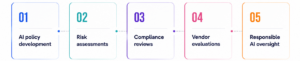
- AI policy development
- Risk assessments
- Compliance reviews
- Vendor evaluations
- Responsible AI oversight
This executive involvement ensures AI initiatives align with both business goals and regulatory expectations.
2. AI Risk Assessments Are Becoming Standard Practice
Before launching new AI solutions, organizations are conducting formal risk evaluations.
These assessments help identify:

- Potential bias risks
- Privacy concerns
- Security vulnerabilities
- Compliance obligations
- Human oversight requirements
Rather than slowing innovation, these reviews help enterprises scale AI more confidently and sustainably.
3. Documentation and Auditability Are Priorities
Regulators increasingly expect organizations to explain how AI systems function and how decisions are made.
As a result, enterprises are investing heavily in:

- AI documentation
- Model tracking
- Decision logs
- Governance workflows
- Audit trails
The ability to demonstrate accountability may soon become as important as model performance itself.
4. Vendor Selection Criteria Are Evolving
When evaluating AI vendors, enterprises are looking beyond functionality and cost.
Questions now include:
- Does the vendor support compliance requirements?
- Are governance controls built into the platform?
- Can AI decisions be explained and audited?
- How is customer data protected?
Regulatory readiness is becoming a major factor in procurement decisions.
Building a Regulation-Ready AI Strategy
Organizations do not need to wait for regulations to become stricter before taking action.
Several practical steps can help prepare for the future.
Establish Clear AI Governance Policies
Define organizational standards for:
- AI usage
- Data management
- Model development
- Human oversight
- Ethical considerations
Clear policies create consistency and reduce risk.
Create Cross-Functional Collaboration
Successful AI governance requires collaboration between:
- Technology teams
- Legal departments
- Risk management
- Compliance teams
- Business leaders
AI is no longer solely a technical initiative.
Invest in AI Literacy
Employees across the organization should understand:
- How AI systems work
- Potential risks
- Compliance requirements
- Responsible usage practices
A workforce that understands AI is better equipped to use it responsibly.
Continuously Monitor Regulatory Changes
The AI regulatory landscape continues to evolve rapidly.
Organizations should establish processes to track:
- New legislation
- Industry standards
- Regulatory guidance
- International compliance requirements
Remaining informed enables proactive planning rather than reactive adjustments.
Conclusion
The age of unregulated AI experimentation is quickly coming to an end.
As governments worldwide introduce new frameworks for AI governance, compliance, and accountability, enterprises must adapt their strategies accordingly.
The organizations that succeed in 2026 and beyond will not simply be those with the most advanced AI capabilities. They will be the ones that combine innovation with governance, speed with responsibility, and growth with trust.
AI regulation should not be viewed as a barrier to innovation.
Instead, it should be seen as a foundation for sustainable, scalable, and responsible AI adoption.
The question for enterprise leaders is no longer whether regulation will influence AI strategy.
The question is how prepared their organization is for the changes already underway.
Frequently Asked Questions
Q1. What is the EU AI Act?
The EU AI Act is a comprehensive regulatory framework introduced by the European Union to govern the development and use of artificial intelligence systems. It categorizes AI applications based on risk levels and establishes compliance requirements for organizations.
Q2. Why should businesses care about AI regulations?
AI regulations help organizations manage risks related to privacy, bias, transparency, accountability, and security. Compliance also strengthens customer trust and reduces potential legal exposure.
Q3. Will AI regulations affect companies outside Europe?
Yes. Similar to GDPR, AI regulations introduced in one region often influence global business practices. Many international organizations are already aligning their AI governance strategies with emerging regulations.
Q4. What is AI governance?
AI governance refers to the policies, processes, controls, and oversight mechanisms organizations use to ensure AI systems are developed and used responsibly, ethically, securely, and in compliance with regulations.
Q5. How can enterprises prepare for future AI regulations?
Organizations should establish governance frameworks, conduct AI risk assessments, improve documentation practices, invest in AI literacy, and continuously monitor regulatory developments.