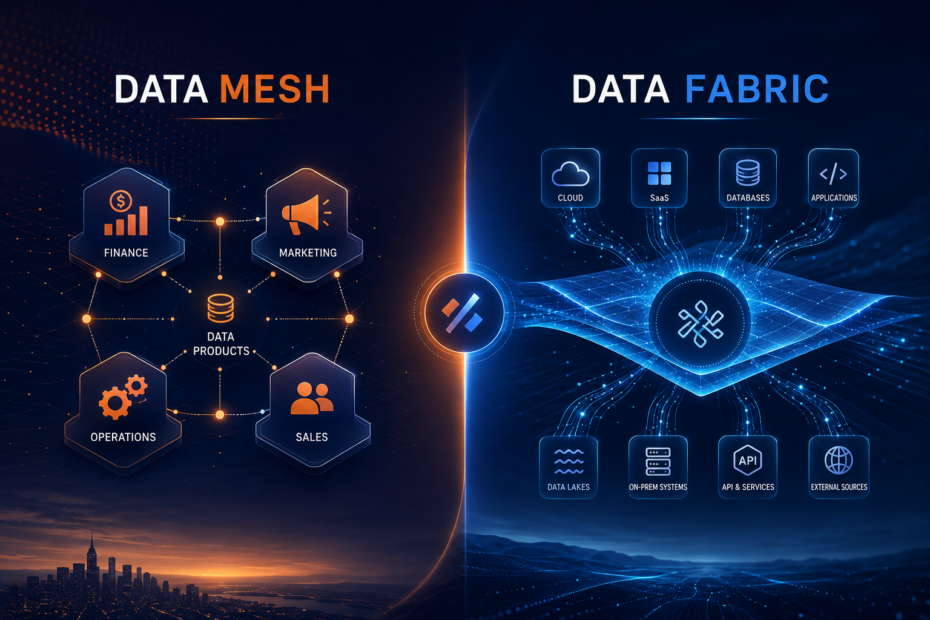
Picture this: your CFO wants a single, trusted revenue number by Friday. Marketing swears their dashboard is right. Finance swears theirs is. Ops has a third number nobody can explain. You’ve got four data teams, six data warehouses, and zero agreement on what “the truth” even looks like.
If that scene feels a little too familiar, you’re not alone — and you’re exactly who this conversation is for.
Every few years, the data world falls head over heels for a new architecture, and half the industry rushes to rip out what it built two years earlier. Right now, the obsession has two names: data mesh and data fabric. If you’re a CTO, Data Architect, or CDO who’s sat through a third vendor pitch this quarter, you’ve probably noticed both terms get thrown around like they mean the same thing.
They don’t. And picking the wrong one isn’t a small mistake — it’s a multi-year, multi-million-dollar bet on how your entire organization accesses, owns, and trusts its data. So let’s actually unpack it, minus the vendor slideware.
The Real Problem Nobody Says Out Loud
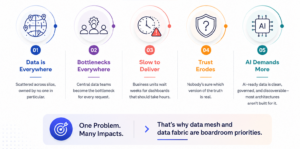
Strip away the buzzwords and it’s the same problem enterprises have wrestled with for a decade: data is everywhere, owned by no one in particular, and painfully slow to turn into anything useful. A central data team becomes the bottleneck for every request. Business units wait weeks for a dashboard that should take hours. Trust erodes because nobody’s sure which version of the truth is real.
Now stack AI on top of that. Every enterprise wants AI-ready data — clean, governed, discoverable data that a model can actually use — and most quickly discover their existing architecture wasn’t built for it. That pressure is exactly why data mesh and data fabric have gone from conference buzzwords to boardroom line items.
Data Mesh: It’s an Org Chart Problem Wearing an Architecture Costume
Data mesh, a concept popularized by Zhamak Dehghani in her widely-read O’Reilly book, is less a technology and more an operating philosophy that happens to need technology. The core idea: stop centralizing data ownership. Let the teams closest to the data — marketing, finance, ops — own it as a genuine data product, complete with documentation, a quality bar, and someone accountable when it breaks.
Four principles hold the whole thing together:
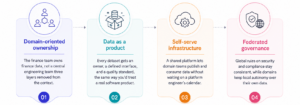
- Domain-oriented ownership — the finance team owns finance data, not a central engineering team three layers removed from the context
- Data as a product — every dataset gets an owner, a defined interface, and a quality standard, the same way you’d treat a real software product
- Self-serve infrastructure — a shared platform lets domain teams publish and consume data without waiting on a platform engineer’s calendar
- Federated governance — global rules on security and compliance stay consistent, while domains keep local autonomy over their own data
The appeal is obvious for sprawling organizations where a central data team simply can’t scale to meet every request. The catch is just as obvious: you’re asking business teams that have never owned infrastructure to suddenly think like product managers. That’s a culture shift, not a software install — and per Forrester’s own estimates, standing up a single mature data mesh domain can run as high as $50 million once you factor in the organizational overhaul. It’s also why so many mesh rollouts stall out around month twelve, right when the novelty wears off and the hard governance conversations begin.
Data Fabric: Fixing the Plumbing Without Touching the Org Chart
Data fabric takes the opposite bet entirely. Instead of redistributing ownership, it stitches together the data you already have — warehouses, lakes, SaaS tools, legacy on-prem systems — through one unified, intelligent layer. Active metadata, increasingly powered by AI and machine learning, does the heavy lifting: mapping relationships automatically, recommending integrations, and surfacing the right data to the right person without anyone moving a single byte.
That last part matters more than it sounds. Modern fabric platforms increasingly rely on zero-copy federation — querying data where it already lives instead of duplicating it everywhere — which keeps governance intact while cutting out the endless copy-paste sprawl that used to define enterprise integration.
Where mesh changes who owns data, fabric changes how data gets connected and discovered. Governance stays centralized. Nobody has to reorganize a single team. What changes is the tooling layer — augmented data catalogs, automated lineage tracking, and integration engines quietly doing the manual plumbing work data engineers used to grind through by hand.
Data Mesh vs Data Fabric: Side by Side
| Data Mesh | Data Fabric |
|---|---|
| Core philosophy Decentralize ownership |
Centralize connectivity |
| Primary driver Organizational scale |
Technical complexity |
| Governance model Federated |
Centralized |
| Where the effort goes Culture, domain accountability |
Metadata, automation, integration |
| Typical rollout time 6–12 months (organizational change) |
4–8 weeks (technical setup) |
| Best suited for Large orgs with distinct, mature domains |
Orgs with fragmented, siloed systems |
| Common failure mode Domains lack the skill or will to own data |
Becomes a shiny catalog nobody actually governs |
So Which One Actually Fits Your Enterprise?
Here’s the answer nobody wants pitched to them: for most enterprises, this was never really an either/or decision.
If your organization has genuinely autonomous business units — think a multinational retailer where each region runs almost like its own company — data mesh’s domain-ownership model maps naturally onto how the business already operates. You’re not fighting the org chart; you’re formalizing it.
If your headache sounds more like “we’ve got forty disconnected systems from a decade of M&A and nobody can find anything,” a data fabric is usually the faster win. You don’t need to restructure a single team before you see value — the integration and discovery layer starts paying for itself almost immediately.
And increasingly, that’s exactly what the data backs up. Analysts now expect the large majority of enterprises to run hybrid architectures rather than picking a side — using a fabric layer for automated discovery, cataloging, and connectivity across the estate, with mesh principles governing how the highest-value domains manage their own data products on top. Grocery giant Kroger is a well-known example of this in practice: it reorganized around business domains for ownership while layering in a metadata-driven fabric underneath to keep everything connected. Treat mesh and fabric as complementary layers of the same composable data architecture, not competing philosophies, and the decision gets a lot less binary.
Three Questions to Ask Before You Commit
- Do our business domains have the maturity to own data as a product? If domain teams have zero appetite for accountability, mesh will stall no matter how good the tooling is.
- Is our biggest pain point access and discovery, or ownership and accountability? Fabric solves the former fast. Mesh solves the latter, slowly and culturally.
- What’s our real governance capability? Federated governance under mesh demands more coordination discipline than most organizations assume going in.
The Real Takeaway
Neither architecture is a silver bullet, and neither one is “wrong.” They’re answers to different root causes of the same frustration — data that’s hard to trust and too slow to use. The enterprises actually winning with this in 2026 aren’t the ones who picked the trendier term at a conference. They’re the ones honest enough to diagnose whether their problem was organizational or technical, and disciplined enough to build accordingly — with a data strategy that treats architecture as a means to an outcome, not a trophy.
FAQs
1. Is data mesh replacing data fabric, or vice versa?
Neither is replacing the other. They solve different root problems — mesh addresses data ownership and accountability, fabric addresses connectivity and discovery. Most large enterprises are now leaning toward hybrid models that use both.
2. Which architecture is easier and faster to implement?
Data fabric is typically faster to show value, often live within weeks, since it works with your existing org structure. Data mesh takes longer, usually six to twelve months, because it requires real organizational change alongside the technical build.
3. Do I need new tools for data mesh, or is it purely organizational?
Both. Data mesh needs a self-serve data platform to make domain ownership practical, but the harder part is almost always getting domain teams to genuinely adopt product-style accountability for their own data.
4. Can a mid-sized company benefit from either approach, or is this only for massive enterprises?
Data fabric scales down reasonably well since it’s mostly about connecting existing systems. Data mesh makes more sense once an organization has several genuinely distinct business domains — it’s overkill for a company with one central data team serving a single product line.
5. How does AI factor into data fabric specifically?
Modern data fabric platforms lean on machine learning to automate metadata tagging, lineage tracking, and integration recommendations, which is a big part of why data fabric is now closely tied to becoming “AI-ready” as an organization.
6. What’s the biggest reason data mesh initiatives fail?
Underestimating the culture shift. Domain teams trained to build reports, not manage products, often aren’t ready for the accountability mesh assumes — and without strong executive alignment, governance tends to fall apart within the first couple of years.