Introduction
Data is no longer just a business asset—it is the foundation of modern decision-making, AI innovation, and competitive advantage. As organizations continue to embrace digital transformation, the demand for scalable, intelligent, and cost-efficient cloud data warehouses has never been higher.
By 2026, the global data landscape is expected to become even more complex, with enterprises managing structured, semi-structured, and unstructured data across multiple cloud environments. In this evolving ecosystem, three platforms consistently dominate conversations among CTOs, CDOs, data architects, and analytics leaders:
- Snowflake
- Databricks
- Google BigQuery

While all three platforms offer powerful capabilities, each takes a different approach to data storage, analytics, AI, and governance.
The question is:
Which cloud data warehouse is the right choice for your organization in 2026?
Let’s explore the strengths, weaknesses, and ideal use cases of each platform to help you make an informed decision.
The Evolution of Cloud Data Warehousing
Traditional on-premises data warehouses struggled with scalability, maintenance, and performance limitations. Cloud-native platforms changed the game by introducing:
- ✔ Elastic scalability
- ✔ Pay-as-you-go pricing
- ✔ Real-time analytics
- ✔ AI and machine learning integration
- ✔ Multi-cloud flexibility
Today’s enterprises expect more than data storage. They need unified data ecosystems that support analytics, AI workloads, governance, and business intelligence from a single platform.
This is where Snowflake, Databricks, and BigQuery have become market leaders.
Understanding the Contenders
Snowflake: The Cloud Data Platform Pioneer
Snowflake transformed cloud analytics by separating storage and compute resources, allowing organizations to scale independently and optimize costs.
Its architecture enables multiple teams to access the same data simultaneously without impacting performance.
Key Strengths
- Multi-cloud support (AWS, Azure, Google Cloud)
- Near-zero infrastructure management
- Secure data sharing capabilities
- Strong governance and compliance features
- High-performance SQL analytics
Best For
- Enterprise reporting
- Data warehousing
- Business intelligence workloads
- Cross-cloud data sharing
- Financial and healthcare organizations with strict compliance requirements
Challenges
- Advanced AI and machine learning workloads often require integration with external tools.
- Costs can increase significantly if workloads are not optimized.
Databricks: The Lakehouse Leader
Databricks pioneered the concept of the Lakehouse architecture, combining the flexibility of data lakes with the governance and performance of data warehouses.
Built on Apache Spark, Databricks has become the preferred platform for organizations heavily invested in AI, machine learning, and data engineering.
Key Strengths
- Unified analytics and AI platform
- Excellent support for machine learning workflows
- Delta Lake architecture
- Strong support for unstructured data
- Advanced data engineering capabilities
Best For
- AI and Generative AI initiatives
- Machine learning teams
- Data science workloads
- Large-scale data engineering projects
- Real-time data processing
Challenges
- Steeper learning curve for non-technical teams
- Governance and BI experiences may require additional configuration compared to Snowflake
Google BigQuery: The Serverless Analytics Powerhouse
Google BigQuery is a fully managed, serverless data warehouse designed for massive-scale analytics.
Organizations benefit from Google’s infrastructure without worrying about provisioning or managing resources.
Key Strengths
- Fully serverless architecture
- Extremely fast analytics
- Native integration with Google Cloud ecosystem
- Built-in AI and machine learning capabilities
- Cost-effective for variable workloads
Best For
- Large-scale analytics
- Marketing analytics
- Real-time dashboards
- Organizations already using Google Cloud
- Data teams seeking minimal operational overhead
Challenges
- Primarily optimized for the Google ecosystem
- Less flexibility for organizations pursuing multi-cloud strategies
Feature-by-Feature Comparison
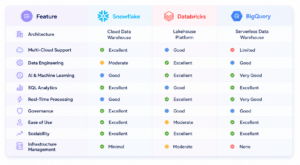
| Feature | Snowflake | Databricks | BigQuery |
|---|---|---|---|
| Architecture | Cloud Data Warehouse | Lakehouse Platform | Serverless Data Warehouse |
| Multi-Cloud Support | Excellent | Good | Limited |
| Data Engineering | Moderate | Excellent | Good |
| AI & Machine Learning | Good | Excellent | Very Good |
| SQL Analytics | Excellent | Good | Excellent |
| Real-Time Processing | Good | Excellent | Very Good |
| Governance | Excellent | Good | Good |
| Ease of Use | Excellent | Moderate | Excellent |
| Scalability | Excellent | Excellent | Excellent |
| Infrastructure Management | Minimal | Moderate | None |
Cost Considerations in 2026
Cost remains one of the most important factors when selecting a cloud data warehouse.
Snowflake
Snowflake charges separately for storage and compute. This provides flexibility but requires active monitoring to avoid unnecessary spending.
Ideal For
Organizations that need predictable performance and enterprise-grade governance.
Databricks
Databricks pricing is based on Databricks Units (DBUs) combined with underlying cloud infrastructure costs.
Ideal For
Organizations prioritizing AI innovation and advanced data engineering.
BigQuery
BigQuery offers consumption-based pricing and serverless operations.
Ideal For
Companies with fluctuating workloads and large analytical queries.
AI Changes Everything in 2026
The cloud data warehouse market is no longer just about analytics.
Generative AI, predictive analytics, and intelligent automation have become major decision drivers.
Snowflake’s AI Direction
Snowflake continues investing in AI through Snowpark, Cortex AI, and integrated machine learning capabilities.
Databricks’ AI Advantage
Databricks remains one of the strongest platforms for building, training, and deploying AI models due to its unified Lakehouse architecture.
BigQuery’s AI Ecosystem
Google integrates BigQuery with Vertex AI, allowing organizations to develop and deploy machine learning models directly within their analytics ecosystem.
For organizations building AI-first strategies, Databricks and BigQuery currently offer stronger native AI ecosystems, while Snowflake continues closing the gap rapidly.
Which Platform Should You Choose?
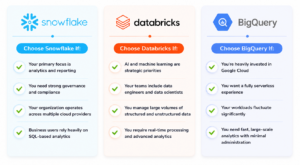
Choose Snowflake If:
- ✔ Your primary focus is analytics and reporting
- ✔ You need strong governance and compliance
- ✔ Your organization operates across multiple cloud providers
- ✔ Business users rely heavily on SQL-based analytics
Choose Databricks If:
- ✔ AI and machine learning are strategic priorities
- ✔ Your teams include data engineers and data scientists
- ✔ You manage large volumes of structured and unstructured data
- ✔ You require real-time processing and advanced analytics
Choose BigQuery If:
- ✔ You’re heavily invested in Google Cloud
- ✔ You want a fully serverless experience
- ✔ Your workloads fluctuate significantly
- ✔ You need fast, large-scale analytics with minimal administration
The Future of Cloud Data Warehousing
The competition among Snowflake, Databricks, and BigQuery is accelerating innovation across the industry.
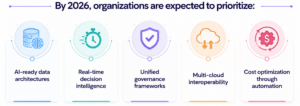
By 2026, organizations are expected to prioritize:
- AI-ready data architectures
- Real-time decision intelligence
- Unified governance frameworks
- Multi-cloud interoperability
- Cost optimization through automation
Rather than choosing a platform solely for data storage, enterprises must evaluate how well each solution supports their broader AI, analytics, and business transformation goals.
The winning platform will not necessarily be the one with the most features—it will be the one that best aligns with your organization’s strategy, skills, and future roadmap.
Conclusion
There is no universal winner in the Snowflake vs Databricks vs BigQuery debate.
Each platform excels in different areas:
- Snowflake leads in simplicity, governance, and multi-cloud analytics.
- Databricks dominates AI, machine learning, and advanced data engineering.
- BigQuery delivers unmatched serverless analytics and seamless Google Cloud integration.
As organizations move toward AI-driven operations in 2026, selecting the right cloud data platform becomes a strategic business decision rather than a purely technical one.
Before making your choice, evaluate your data maturity, AI ambitions, cloud strategy, compliance requirements, and total cost of ownership.
The organizations that align their platform selection with long-term business objectives will be best positioned to unlock the full value of their data.
Frequently Asked Questions (FAQs)
1. Which cloud data warehouse is best for AI and machine learning in 2026?
Databricks is generally considered the strongest option for AI and machine learning because of its Lakehouse architecture, Apache Spark foundation, and integrated ML capabilities.
2. Is Snowflake better than Databricks?
It depends on your use case. Snowflake is typically better for business intelligence, reporting, and governance, while Databricks excels in AI, machine learning, and data engineering.
3. Why do organizations choose BigQuery?
Organizations choose BigQuery for its serverless architecture, fast analytics, scalability, and seamless integration with the Google Cloud ecosystem.
4. Which platform is most cost-effective?
Cost-effectiveness depends on workload patterns. BigQuery is often attractive for variable workloads, Snowflake offers flexible scaling, and Databricks provides value for AI-intensive use cases.
5. Can enterprises use multiple platforms?
Yes. Many enterprises adopt a multi-platform strategy where Snowflake, Databricks, and BigQuery coexist to support different workloads and business objectives.
6. What is the biggest trend in cloud data warehousing for 2026?
The biggest trend is the convergence of analytics, AI, governance, and real-time processing into unified data platforms that support decision intelligence at scale.