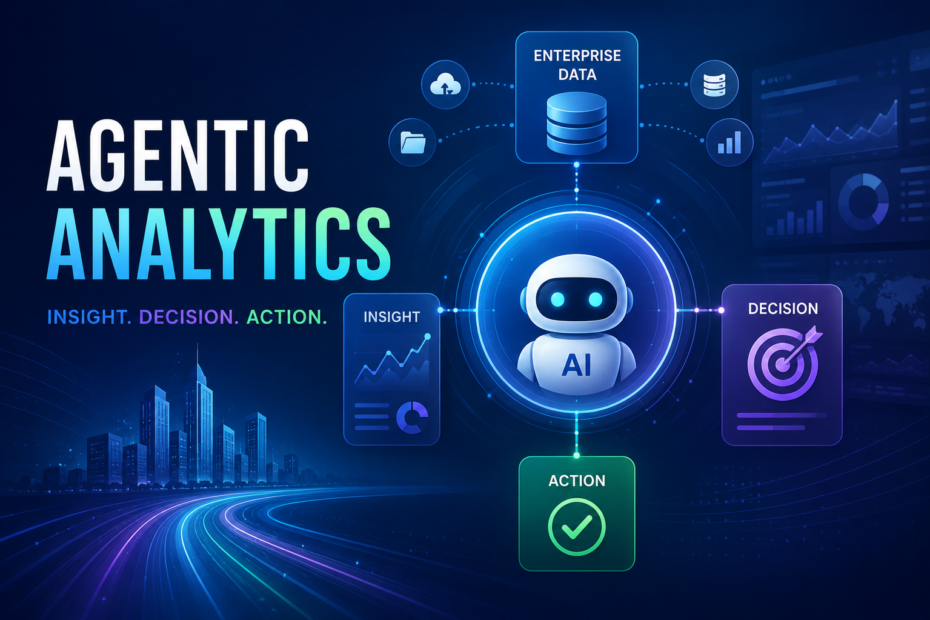
For years, enterprise analytics followed a familiar pattern: collect data, build dashboards, analyze trends, and let business teams decide what to do next.
That model is changing.
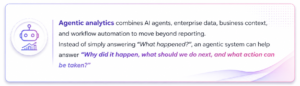
Agentic analytics combines AI agents, enterprise data, business context, and workflow automation to move beyond reporting. Instead of simply answering “What happened?”, an agentic system can help answer “Why did it happen, what should we do next, and what action can be taken?”
This shift matters because AI adoption is already widespread. McKinsey reported in 2025 that 78% of organizations were using AI in at least one business function, while its 2025 global survey found that 62% of respondents said their organizations were at least experimenting with AI agents.
Gartner also predicted that 40% of enterprise applications will feature task-specific AI agents by the end of 2026, compared with less than 5% in 2025.
For enterprise leaders, the question is no longer whether AI agents are coming. The bigger question is whether the organization’s data, architecture, security, and governance are ready for them.
What Is Agentic AI in Enterprise Analytics?
Agentic analytics is an approach where AI agents can understand a business goal, access governed enterprise data, perform multi-step analysis, generate insights, and when authorized recommend or execute an action.
Traditional analytics generally requires a person to move between several steps:
Data → Dashboard → Analysis → Decision → Action
Agentic analytics aims to connect those steps:
Data → AI reasoning → Insight → Recommendation → Governed action
The goal is not to remove humans from decision-making. Instead, agents can handle repetitive analytical work while people focus on judgment, strategy, and exceptions.
Tableau describes agentic analytics as a shift toward human collaboration with AI agents across the journey from data to insight to action.
Expert insight Gartner: “AI agents will evolve rapidly” from task-specific agents toward broader agentic ecosystems.

Agentic AI vs Traditional BI vs Augmented Analytics
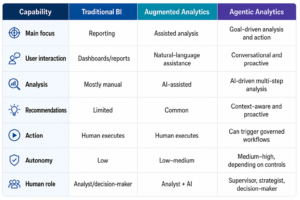
The key distinction: agentic analytics is not simply a chatbot added to a dashboard. It requires the ability to reason across data, context, tools, and workflows.
How Does Agentic Analytics Actually Work?
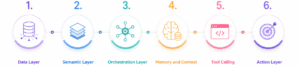
A practical enterprise architecture can be understood through six layers:
1. Data Layer
This includes databases, warehouses, CRM systems, ERP platforms, IoT data, applications, and external data sources.
2. Semantic Layer
The semantic layer explains what the data means.
For example, an agent needs to understand that “revenue,” “net sales,” and “recognized revenue” may represent different business definitions.
This layer is especially important because poor semantics can produce incorrect or misleading AI answers. Databricks notes that flawed semantics and fragmented governance can create major problems when agents operate at enterprise scale.
3. Orchestration Layer
The orchestration layer determines what the agent should do, which data or tools it needs, and the sequence of steps required to complete a task.
4. Memory and Context
Memory allows an agent to retain relevant context, business rules, previous interactions, and approved preferences.
5. Tool Calling
Agents can call approved tools such as SQL queries, forecasting models, CRM systems, APIs, or workflow platforms.
6. Action Layer
The final layer connects insight to action for example, creating an alert, updating a workflow, opening a service ticket, or requesting human approval.
This architecture is what makes enterprise agentic analytics different from simply asking an LLM a question about a spreadsheet.
Four Enterprise Use Cases
1. Retail and Hypermarkets: Smarter Inventory Decisions
A retailer may have thousands of products across stores, warehouses, and online channels.
An analytics agent could monitor sales, inventory, promotions, seasonality, and supply data to identify products at risk of stockouts or overstock.
Instead of waiting for a manager to discover the issue in a dashboard, the system could surface the problem and recommend an appropriate action.
2. Manufacturing: Predictive Maintenance
Manufacturing organizations generate large volumes of machine and operational data.
An agent can combine equipment readings, maintenance history, production schedules, and failure patterns to identify potential problems.
The objective is not simply to report that a machine’s performance has changed. The system can help determine why, estimate potential operational impact, and recommend the next maintenance step.
3. Healthcare: Operational Intelligence
Healthcare organizations must balance patient needs, staffing, resources, costs, and compliance requirements.
Agentic analytics can help identify patterns in appointment demand, resource utilization, patient flow, or operational bottlenecks.
For sensitive healthcare decisions, however, human oversight and strict access controls remain essential.
4. BFSI: Risk and Fraud Monitoring
Banks and financial institutions can use analytics agents to analyze transactions, customer behavior, risk indicators, and historical patterns.
An agent could identify unusual activity, summarize relevant evidence, and route a case for review.
For regulated decisions, the agent should operate within clearly defined permissions and maintain an auditable record of how the recommendation was generated.
The Biggest Challenge: Trust
The biggest mistake enterprises can make is focusing on agent intelligence before focusing on agent governance.
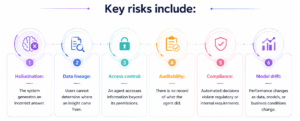
Key risks include:
- Hallucination: The system generates an incorrect answer.
- Data lineage: Users cannot determine where an insight came from.
- Access control: An agent accesses information beyond its permissions.
- Auditability: There is no record of what the agent did.
- Compliance: Automated decisions violate regulatory or internal requirements.
- Model drift: Performance changes as data, models, or business conditions change.
The governance challenge is real. Deloitte reported in 2026 that only 21% of surveyed organizations had a mature governance model for agentic AI.
IBM’s 2026 research similarly found that only 11% of surveyed technology leaders said they were completely prepared for the scale of AI-agent deployment.
Expert insight Deloitte: “winning might not be about moving first, but about putting safety first.”
For Aitobi, this is where analytics architecture and governance become equally important. Aitobi already works across data analysis, machine learning, AI, predictive modeling, data visualization, and data governance, creating a foundation for organizations moving toward more intelligent analytics.
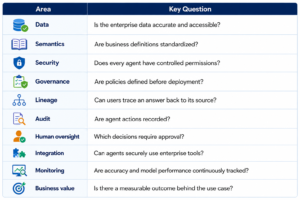
Agentic Analytics Readiness Checklist for CIOs
Before moving from pilot to production, leaders should ask:
A 30/60/90-Day Roadmap
Days 1–30: Prepare
- Select one high-value, low-risk use case.
- Audit data quality and access.
- Define business metrics.
- Identify governance requirements.
- Document human approval points.
Days 31–60: Pilot
- Connect the agent to governed data.
- Test semantic accuracy.
- Introduce approved tool calling.
- Track errors and hallucinations.
- Keep humans in the approval loop.
Days 61–90: Scale Carefully
- Measure business impact.
- Improve workflows based on user feedback.
- Expand integrations.
- Strengthen monitoring and audit trails.
- Decide whether to scale, redesign, or stop the use case.
A phased approach is important because current research shows that many organizations are experimenting with AI but have not yet achieved enterprise-wide scale.
Metrics Enterprise Leaders Should Track
Agentic analytics should be measured by business outcomes not simply by how many AI agents are deployed.
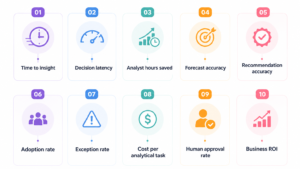
Key metrics include:
- Time to insight
- Decision latency
- Analyst hours saved
- Forecast accuracy
- Recommendation accuracy
- Adoption rate
- Exception rate
- Cost per analytical task
- Human approval rate
- Business ROI
The most valuable question is simple:
Is the organization making better decisions faster and more safely?
What This Means for Enterprise Leaders
Agentic analytics is not the end of dashboards, BI platforms, or analysts.
It is an evolution of how enterprises use them.
Dashboards remain valuable for monitoring KPIs and maintaining a shared view of business performance. Analysts remain essential for complex reasoning, business context, validation, and strategic decisions.
The difference is that AI agents can increasingly handle the repetitive work between seeing a signal and responding to it.
Expert insight Tableau: “agentic analytics is not just another LLM add-on.”
The organizations most likely to benefit will not necessarily be those deploying the largest number of agents. They will be the organizations that build trusted data foundations, clear semantic models, controlled access, measurable workflows, and strong governance.
For organizations evaluating their analytics foundation, Aitobi provides services across data analysis, AI, predictive modeling, data visualization, and data governance.
Key Takeaways
- Agentic analytics goes beyond dashboards. It connects data, AI reasoning, recommendations, and business actions.
- Data quality comes first. Agents can only be as reliable as the data, business definitions, and context they use.
- Governance is essential. Access controls, data lineage, audit trails, human approvals, and compliance must be built into the architecture.
- Start with focused use cases. Retail inventory, manufacturing maintenance, healthcare operations, and BFSI risk management are practical areas to explore.
- Measure business impact. Track time to insight, decision latency, analyst hours saved, forecast accuracy, adoption, and ROI.
- AI agents do not eliminate analysts. They can reduce repetitive work while analysts remain responsible for judgment, validation, and strategic decisions.
- Enterprise readiness matters more than AI experimentation. Organizations should establish trusted data and governance before scaling agentic analytics across business functions.
Conclusion: From Reporting to Intelligent Decision-Making
Enterprise analytics is entering a new phase.
Traditional BI helped organizations understand what happened. Augmented analytics made it easier to explore data and discover patterns. Agentic analytics takes the next step by connecting insights with recommendations and, where appropriate, business actions.But successful adoption is not simply about adding an AI agent to an existing analytics platform. Enterprises need trusted data, consistent business definitions, secure access, reliable integrations, human oversight, and strong governance.
For CIOs and business leaders, the best starting point is not asking, “Where can we use AI agents?” Instead, ask:“Which business decision could become faster, better, and more reliable if an AI agent handled the analytical work around it?”
That question helps organizations focus on measurable business value rather than AI experimentation for its own sake.
The opportunity for enterprise agentic analytics is significant but so is the responsibility to implement it carefully. Organizations that combine intelligent automation with trustworthy data and strong governance will be better positioned to move from simply analyzing the business to continuously understanding, deciding, and acting on it.
For organizations evaluating their readiness, Aitobi can help build the data, analytics, AI, visualization, and governance foundations needed for this transition.
Ready to explore how agentic analytics could work for your enterprise?
Talk to our experts
Frequently Asked Questions
What is agentic AI in enterprise analytics?
Agentic AI in enterprise analytics uses AI agents to understand business goals, access governed data, perform multi-step analysis, generate insights, and potentially recommend or execute approved actions. Unlike a traditional analytics tool, the agent can coordinate multiple steps instead of waiting for a user to perform each step manually.
How is agentic analytics different from traditional BI?
Traditional BI primarily helps users view and analyze historical or current data through reports and dashboards. Agentic analytics adds AI-driven reasoning, proactive insight generation, multi-step analysis, and connections to business workflows. It aims to shorten the journey from data to insight to action.
How does agentic analytics actually work?
Agentic analytics combines enterprise data, a semantic layer, AI models, orchestration, memory, tool calling, and an action layer. The agent interprets a request, determines what information it needs, retrieves and analyzes data, explains its findings, and when permitted initiates the next workflow step.
What are the top use cases of agentic AI in analytics?
Common enterprise opportunities include inventory optimization in retail, predictive maintenance in manufacturing, operational analytics in healthcare, and fraud or risk monitoring in BFSI. Other use cases include customer service, supply-chain planning, forecasting, and financial analysis.
Is agentic AI replacing dashboards and analysts?
No. Agentic analytics is better understood as an extension of analytics rather than a replacement for BI or people. Dashboards remain useful for monitoring and communication, while analysts provide business judgment and validation. AI agents can reduce repetitive analytical work and help teams reach insights faster.
References
1. Gartner, 2025 “Gartner Predicts 40% of Enterprise Apps Will Feature Task-Specific AI Agents by 2026.”
2. McKinsey, 2025 “The State of AI: How Organizations Are Rewiring to Capture Value.” The research reported 78% organizational AI adoption in at least one business function.
3. Deloitte, 2026 “Business and IT leaders report AI agents are scaling faster than their guardrails.” The research found only 21% of surveyed organizations had mature governance for agentic AI.