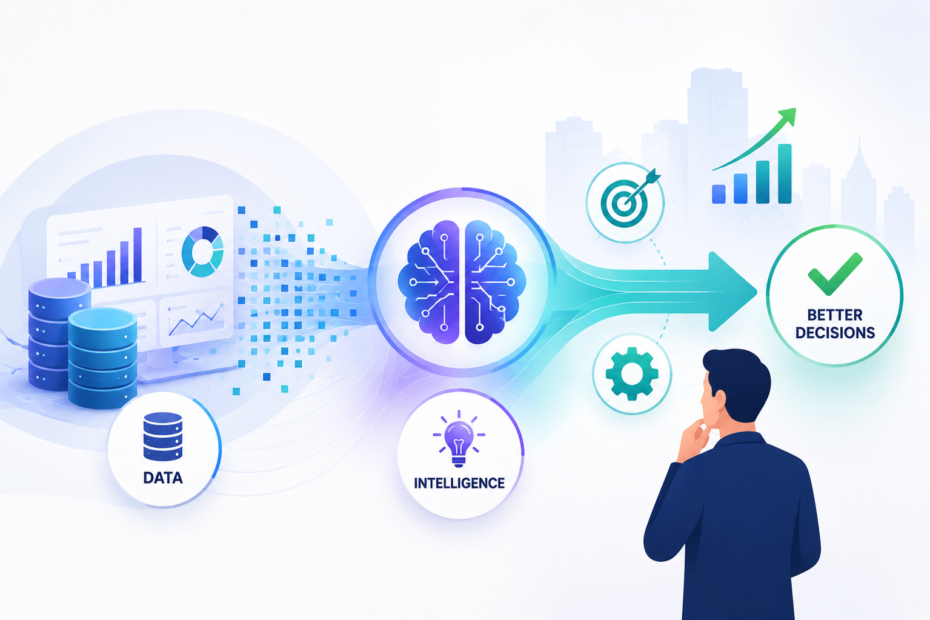
Businesses have spent years investing in dashboards, reports, data warehouses, and business intelligence (BI) platforms. But a growing gap remains between having information and knowing what to do with it.
Decision intelligence (DI) closes that gap by combining data, analytics, AI, decision modeling, and business rules to improve and increasingly automate complex decisions.
Key Takeaway: Business intelligence explains what happened. Predictive analytics estimates what may happen. Decision intelligence goes further by connecting insights to recommended or automated actions. By combining AI, analytics, decision models, governance, and human oversight, enterprises can turn data into faster, more consistent, and measurable business decisions.
What Is Decision Intelligence?
Decision intelligence is a decision-centric approach that combines data, analytics, AI, business rules, and decision modeling to improve or automate business decisions.
Unlike traditional analytics, DI focuses on the complete journey from data → insight → decision → action → outcome → feedback.
Gartner describes decision intelligence as combining data, analytics, and AI to create decision flows that support and automate complex judgments.
Why Is Decision Intelligence the Next Frontier After Business Intelligence?
The evolution is straightforward:
| Stage | Core Question | Outcome |
|---|---|---|
| Descriptive BI | What happened? | Reports and dashboards |
| Predictive Analytics | What could happen? | Forecasts and predictions |
| Decision Intelligence | What should we do? | Recommendations and actions |
Traditional BI remains essential, but it often leaves the final decision to humans. DI connects analytical insight to decision logic and action.
The market is moving in that direction. Grand View Research estimates the global decision intelligence market will grow from $20.7 billion in 2026 to $53.2 billion by 2033, representing a 14.4% CAGR.
Gartner predicts that by 2027, 50% of business decisions will be augmented or automated by AI agents for decision intelligence.
Prescriptive Analytics vs Decision Intelligence
Prescriptive analytics recommends what action could improve an outcome. Forrester defines it broadly as analytics, mathematics, experiments, simulation, and/or AI used to improve decision effectiveness.
Decision intelligence is broader. It considers the entire decision process, including data, business rules, people, workflows, governance, automation, and feedback.
Think of prescriptive analytics as helping answer “what should we do?”, while DI helps design and manage how that decision is made and acted upon.
Decision Intelligence Use Cases for Enterprises

Supply Chain and Retail
Retailers can combine demand forecasts, inventory, promotions, pricing, and external signals to recommend replenishment levels or identify potential stockouts.
Healthcare Operations
Healthcare organizations can use DI to improve staffing, capacity planning, patient flow, scheduling, and resource allocation while maintaining human oversight for sensitive decisions.
Finance and Risk
Financial organizations can combine transaction data, predictive models, business rules, and risk thresholds to support fraud detection, credit decisions, forecasting, and compliance workflows.
Manufacturing
Manufacturers can use AI decision intelligence for predictive maintenance, production scheduling, quality control, inventory planning, and anomaly detection.
These applications turn analytics from something people consult into something that actively supports how the business operates.
How Does AI Decision Intelligence Work?
AI decision intelligence combines several capabilities:
Data + Analytics + AI/ML + Decision Modeling + Business Rules + Workflow + Feedback
AI can identify patterns and generate predictions. Decision models determine how those insights should influence a decision. Workflow systems then deliver or execute the appropriate action.
A mature DI environment can also use DecisionOps, the operational discipline around managing, monitoring, governing, and improving decision processes.
The result is a closed feedback loop:

AITOBI’s CEO, Roushan Kumar, emphasizes the importance of connecting AI and data capabilities to real-world business outcomes: “Driving Digital Innovation with CRM, CMS and Data Science” is central to his leadership focus at AITOBI.
How Do You Move From BI to Decision Intelligence?
Moving to DI does not mean replacing existing BI investments.
Start by identifying decisions where better speed, accuracy, or consistency can create measurable value.
Decision Intelligence Maturity Model
| Level | Capability | Focus |
|---|---|---|
| 1. Reporting | Descriptive BI | Understand the past |
| 2. Predictive | Forecasting | Anticipate outcomes |
| 3. Prescriptive | Recommendations | Identify better actions |
| 4. Decision Intelligence | Decision workflows | Connect insight to action |
| 5. Decision Automation | AI agents + automation | Execute governed decisions |
Leaders should prioritize high-value decisions, establish trusted data foundations, define decision logic, introduce human-in-the-loop controls, and measure outcomes continuously.
Key metrics include decision velocity, decision accuracy, time-to-decision, forecast accuracy, adoption, and business ROI.
AITOBI’s approach to AI and data analytics similarly focuses on helping organizations extract insights and make better-informed decisions through data analysis, machine learning, AI, predictive modeling, and visualization.
What Are the Risks or Limitations of Decision Intelligence?
More automation does not automatically mean better decisions.
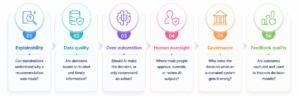
Organizations must address:
- Explainability: Can stakeholders understand why a recommendation was made?
- Data quality: Are decisions based on trusted and timely information?
- Over-automation: Should AI make the decision, or only recommend an action?
- Human oversight: Where must people approve, override, or review AI outputs?
- Governance: Who owns the decision when an automated system gets it wrong?
- Feedback quality: Are outcomes captured and used to improve decision models?
This is increasingly important as AI agents become part of decision workflows. Gartner has warned that more than 40% of agentic AI projects could be canceled by the end of 2027 because of escalating costs, unclear value, or inadequate risk controls.
The goal of DI is therefore not maximum automation. It is better, governed decision-making.
Conclusion
The next evolution of analytics is not about creating another dashboard.
It is about creating a stronger connection between insight and action.
Business intelligence tells organizations what happened. Predictive analytics helps them anticipate what could happen. Decision intelligence brings those capabilities together with AI, decision modeling, workflows, governance, and feedback to determine what should happen next.
For enterprises, that means faster decisions, greater consistency, better resource allocation, and a clearer path from data investment to business value.
The organizations that succeed with AI decision intelligence will not necessarily be the ones with the most models.
They will be the ones that identify their most important decisions and build intelligent, measurable, and governed systems around them.
Ready to turn your data into better decisions?
References
- Gartner (2025) – Gartner Announces the Top Data & Analytics Predictions. Gartner predicts that by 2027, 50% of business decisions will be augmented or automated by AI agents for decision intelligence.
- Grand View Research (2026) – Decision Intelligence Market. The market is projected to reach $53.2 billion by 2033 at a 14.4% CAGR.
- Forrester (2017) – What Exactly The Heck Are Prescriptive Analytics? Forrester’s definition and explanation of prescriptive analytics and its relationship to decision effectiveness.
FAQs
What is decision intelligence?
Decision intelligence combines data, analytics, AI, decision modeling, business rules, and workflows to improve or automate complex business decisions.
How is decision intelligence different from business intelligence?
BI primarily explains what happened through reports and dashboards. DI connects data and analytics to recommendations, actions, workflows, and feedback.
Is decision intelligence replacing BI and dashboards?
No. BI remains an important foundation for DI. Decision intelligence builds on trusted BI, analytics, and data infrastructure to connect insights with decisions and actions.
What are real-world examples of decision intelligence?
Examples include demand planning, inventory optimization, healthcare capacity planning, fraud detection, financial risk decisions, predictive maintenance, and production scheduling.
How do you move from BI to decision intelligence?
Start with high-value decisions, establish trusted data and semantic definitions, build predictive or prescriptive models, integrate decision logic into workflows, add governance and human oversight, and continuously measure outcomes.
What are the risks or limitations of decision intelligence?
Key risks include poor data, lack of explainability, over-automation, model bias, unclear accountability, insufficient monitoring, and weak human oversight.