Manufacturing has never been a simple business of making products and moving them from one place to another. A change in customer demand, a delayed shipment, a supplier issue, a machine breakdown, or a sudden change in raw material availability can quickly affect the entire operation.
The challenge is that many manufacturers still discover these problems after they have already started affecting production.
This is where supply chain predictive analytics is changing the game.
Instead of looking only at what happened yesterday, predictive analytics helps manufacturers examine historical and real-time data to understand what is likely to happen next. The goal is not to replace human decision-making. It gives planners, procurement teams, operations managers, and supply chain leaders enough visibility to act earlier and with greater confidence.
What Is Supply Chain Predictive Analytics?
Supply chain predictive analytics uses historical data, current operational information, statistical techniques, and machine learning models to identify patterns and estimate future outcomes.
For a manufacturer, that could mean predicting:
- Which products are likely to experience higher demand
- When inventory may fall below a required level
- Which suppliers could create delivery risks
- When transportation delays may affect production
- Which machines are showing signs of potential failure
- Where production capacity could become a bottleneck
Traditional reporting might tell a supply chain manager that inventory is already low. Predictive analytics asks a more useful question:
“Based on everything we know today, what is likely to happen next?”
That shift from reacting to anticipating is where the real value lies.
Why Predictive Analytics Matters in Manufacturing Supply Chains
Manufacturing supply chains are interconnected. A problem at one point can quickly create consequences somewhere else.
For example, a supplier delay can cause a component shortage. That shortage can delay production. The production delay can affect customer orders, creating additional transportation and scheduling problems.
Predictive analytics helps teams identify these relationships earlier.
Gartner notes that supply chain leaders are dealing with more frequent disruptions and highlights predictive supply chain analytics as an approach for anticipating and responding to disruptions.
For manufacturers, this can support better decisions around demand planning, inventory, procurement, production scheduling, logistics, and supplier management.
How Predictive Analytics Differs From Traditional Supply Chain Analytics
Not all analytics answer the same question.
| Type of Analytics | Main Question | Manufacturing Example |
|---|---|---|
| Descriptive | What happened? | Which products were sold last month? |
| Diagnostic | Why did it happen? | Why did production fall last week? |
| Predictive | What is likely to happen? | Which products may face demand increases next month? |
| Prescriptive | What should we do? | Should we reorder, reschedule production, or use another supplier? |
Descriptive dashboards remain important because businesses need visibility into current and historical performance.
But predictive analytics takes it a step further. It uses available information to estimate future outcomes.
Prescriptive analytics can then take that insight further by recommending possible actions. IBM describes predictive analytics as helping anticipate future demand and outcomes, while prescriptive analytics can help optimize decisions around production, scheduling, inventory, and logistics.
The strongest supply chain environments connect all four levels rather than treating them as separate activities.
What Data Do Manufacturers Need for Predictive Analytics?
A predictive model is only as useful as the information supporting it.
Manufacturers can bring together data from several parts of the business, including:
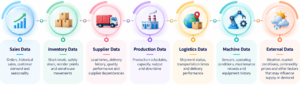
The real challenge is often not the lack of data. It is that the data sits in different systems.
ERP, MES, warehouse, procurement, CRM, IoT and logistics platforms may all contain valuable information. Bringing these sources together creates a much more complete view of the supply chain.
AItoBI’s work across data analysis, machine learning, predictive modeling, and data visualization can help organizations turn fragmented operational data into more useful business insights.
Predictive Maintenance: Connecting Factory Health With Supply Chain Performance
A supply chain problem does not always begin with a supplier or transportation provider.
Sometimes, it begins inside the factory.
A machine that unexpectedly fails can stop a production line, delay orders, change production schedules and create downstream logistics problems.
This is why predictive maintenance is closely connected to supply chain performance.
Instead of servicing equipment on a fixed schedule or waiting for a breakdown, predictive maintenance uses operational and condition data to identify signs that equipment may need attention. IBM describes predictive maintenance as using real-time condition monitoring and technologies such as AI and IoT to identify potential failures before they occur.
For example, abnormal vibration or temperature readings from a machine may indicate a developing issue. If that warning reaches the maintenance team early enough, the team may be able to schedule maintenance during planned downtime rather than dealing with an unexpected production stoppage.
That is where manufacturing predictive analytics becomes more than a maintenance exercise. It becomes part of supply chain resilience.
Predicting Supply Chain Disruptions Before They Happen
No analytics system can predict every disruption with certainty.
But manufacturers can use predictive models to identify warning signals and estimate the potential impact of known risks.
Consider a simple scenario.
A critical component normally takes 10 days to arrive from a supplier. Recent delivery records show that lead times are gradually increasing. At the same time, inventory levels are declining, and customer orders are rising.
A traditional report may show each of these facts separately.
A predictive system can connect them and flag a potential shortage.
The supply chain team could then investigate whether it makes sense to:
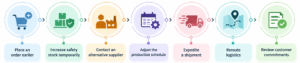
This is one of the clearest examples of how predictive analytics reduces supply chain disruptions: not by eliminating uncertainty, but by giving teams more time to respond.
What Top Manufacturing Enterprises Do Differently
Leading organizations do not treat predictive analytics as another dashboard project.
They connect analytics to actual business decisions.
They also focus on data quality and accessibility before expecting sophisticated models to solve everything.
Three practices matter particularly:
1. They connect data across functions.
Supply chain decisions rarely belong to one department. Procurement, production, inventory, logistics, and sales data need to work together.
2. They focus on business questions.
Instead of asking, “Where can we use AI?”, they ask, “Which decision is costing us time, money or reliability today?”
3. They build analytics into workflows.
A prediction that nobody acts on has limited business value.
This is why successful analytics initiatives combine data science with business processes, technology integration, and user adoption.
From Prediction to Action: The Missing Step in Supply Chain Analytics
This is perhaps the most important part of the conversation.
A prediction alone does not improve a supply chain.
Suppose a model predicts that a product has an 80% likelihood of running out of stock within two weeks.
What happens next?
Does the procurement team receive an alert?
Does the system recommend a reorder quantity?
Does production get notified?
Does the planner evaluate an alternative supplier?
Does logistics check whether an expedited shipment is possible?
The real value appears when predictive insights are connected to action.
For example:
Prediction → Alert → Decision → Action → Outcome
That action could mean reordering inventory, rescheduling production, expediting a shipment, rerouting goods, reviewing a supplier, or escalating a risk.
This is also where predictive analytics for manufacturing inventory management becomes particularly useful. Instead of relying entirely on fixed reorder rules, manufacturers can consider demand patterns, supplier lead times, inventory levels and operational conditions together.
Common Challenges When Implementing Predictive Analytics in Manufacturing
Predictive analytics sounds straightforward until an organization starts working with real operational data.
Common challenges include:
Poor Data Quality
Missing values, inconsistent formats, duplicate records and inaccurate timestamps can affect model reliability.
Siloed Systems
Data may be spread across ERP, MES, warehouse, procurement and logistics platforms, making it difficult to create one consistent view.
Legacy Technology
Older systems may not easily connect with modern analytics platforms or machine learning environments.
Model Reliability
A model should be tested, monitored and periodically reviewed. Business conditions change, and a model that worked well previously may need adjustment.
Integration
Insights need to reach the people and systems responsible for taking action. A prediction trapped inside an analytics dashboard is unlikely to deliver its full value.
User Adoption
Planners and operations teams need to understand why a recommendation was generated and how it fits into their existing workflows.
The technology matters, but successful implementation ultimately depends on people, processes, and data working together.
Turning Supply Chain Data Into a Competitive Advantage
Manufacturing will always involve uncertainty. Customer demand will change. Suppliers will face challenges. Machines will eventually require maintenance. Transportation will sometimes run late.
The goal of predictive analytics is not to make those uncertainties disappear.
It is to help manufacturers see them earlier.
When sales, inventory, supplier, production, machine and logistics data are connected, organizations can move beyond simply reporting what happened. They can start anticipating what may happen and, more importantly, deciding what to do about it.
That is the real edge of supply chain predictive analytics.
At AItoBI, we help organizations bring together data analytics, machine learning, predictive modeling and visualization to turn complex business data into actionable insights.
External Reference
- Gartner – Supply Chain Analytics for CSCOs: Gartner highlights the growing frequency of supply chain disruptions and the role of predictive analytics in anticipating and responding to disruption.
References
- Gartner, Supply Chain Analytics for CSCOs.
- IBM, What is Supply Chain Analytics?
- IBM, What is Predictive Maintenance?
FAQs
What is supply chain predictive analytics?
It uses historical and current supply chain data, statistical methods, and machine learning to identify patterns and forecast potential future outcomes such as demand changes, inventory shortages, supplier delays, and operational risks.
How can predictive analytics improve manufacturing?
It can help manufacturers make better-informed decisions around demand forecasting, inventory, production planning, supplier management, logistics and equipment maintenance.
Can predictive analytics prevent supply chain disruptions?
It cannot guarantee that disruptions will never happen. However, it can identify risk signals earlier, giving teams more time to prepare and respond.
What data is required for predictive analytics?
Common inputs include sales, inventory, supplier, production, logistics, machine and external market data. The exact requirements depend on the business problem being addressed.
Is predictive analytics useful for inventory management?
Yes. Predictive models can help manufacturers understand future demand and inventory risks, allowing teams to make more informed decisions about replenishment, safety stock and production planning.