“Modern business intelligence is the ability to transform trusted data into timely, actionable decisions, not just reports.”
For years, business intelligence (BI) was synonymous with dashboards and reports. Organizations invested heavily in visualization tools, expecting better insights to automatically lead to better decisions. Yet, many executives still struggle with delayed actions, siloed data, and reports that rarely influence business outcomes.
The reality is simple: reports don’t make decisions, people do. And today’s organizations need BI platforms that actively support those decisions with AI, automation, and real-time intelligence.
This shift is giving rise to a new era where modern business intelligence acts as a decision engine, empowering organizations to move beyond reporting and toward meaningful business outcomes.
What Is Modern Business Intelligence?
Modern business intelligence combines real-time data, AI, automation, and self-service analytics to help organizations make faster and smarter decisions.
Unlike traditional BI, which primarily focuses on historical reporting, modern BI integrates predictive analytics, natural language queries, and AI-assisted recommendations. Platforms such as Tableau, Tableau Next, Power BI, and Agentforce enable business users to explore data independently and act with confidence.
Business Intelligence vs. Decision Intelligence: What’s the Difference?
Business intelligence explains what happened, while decision intelligence recommends what should happen next.
| Traditional BI | Decision Intelligence |
|---|---|
| Historical reports | Real-time insights |
| Describes past performance | Recommends next actions |
| Manual reporting | AI-assisted recommendations |
| IT-driven dashboards | Self-service analytics |
| Static visualizations | Predictive & conversational analytics |
Decision Intelligence combines analytics, AI, business context, and automation to help organizations make better decisions faster.
Why Don’t BI Dashboards Drive Business Outcomes?
Because dashboards inform people, but they don’t always drive action.
Many organizations invest in dashboards expecting instant transformation. Instead, they end up with dozens of reports that few employees regularly use.
According to industry research, many BI dashboards experience low ongoing adoption because users struggle to connect insights with day-to-day decisions. Organizations also face challenges from disconnected data sources, manual reporting processes, and delayed insights.
Without trusted data, governance, and AI-driven recommendations, dashboards often become a reporting tool rather than a decision-making tool.
7 Powerful Ways Modern Business Intelligence Drives Smarter Decisions
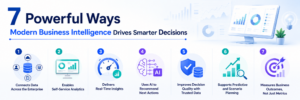
1. Connects Data Across the Enterprise
Modern BI integrates information from multiple systems into one trusted view, eliminating data silos and creating a single source of truth.
2. Enables Self-Service Analytics
Self-service analytics empowers business users to answer their own questions without relying on IT teams, reducing reporting delays and increasing agility.
3. Delivers Real-Time Insights
Waiting for weekly or monthly reports is no longer enough.
Modern BI platforms provide live dashboards and alerts so leaders can respond to opportunities and risks as they happen.
4. Uses AI to Recommend Next Actions
With solutions like Tableau Next and Agentforce, analytics is becoming conversational.
Instead of simply displaying data, AI suggests trends, highlights anomalies, and recommends actions, helping organizations move from observation to execution.
5. Improves Decision Quality with Trusted Data
Poor data quality leads to poor decisions.
Modern BI combines governance, metadata, and semantic layers to ensure everyone is working with accurate, trusted information.
As the saying goes:
Better data leads to better decisions.
6. Supports Predictive and Scenario Planning
Modern BI doesn’t stop at explaining yesterday’s performance.
Using predictive analytics, organizations can forecast future demand, identify potential risks, and evaluate different business scenarios before making strategic decisions.
7. Measures Business Outcomes, Not Just Metrics
The best BI strategies focus on business impact rather than dashboard views.
Whether improving patient outcomes, reducing operational costs, or increasing customer satisfaction, modern BI connects analytics directly to measurable business goals.
Mini Success Story
A healthcare organization relied on monthly spreadsheets to monitor rural health program performance. By the time reports were compiled, opportunities to improve outcomes had already passed.
After adopting Tableau with AI-powered analytics, program managers gained real-time visibility into key performance indicators, received proactive alerts, and significantly reduced manual reporting efforts. Instead of reacting to historical data, they began making faster, data-driven decisions that improved program impact.
Is Your BI a Decision Engine?
Ask yourself these questions:
- Can business users access insights without IT support?
- Does your BI platform provide real-time data?
- Are AI-powered recommendations part of your workflow?
- Is your data governed and trusted?
- Can you predict future outcomes instead of only reporting past events?
- Are business decisions directly linked to measurable KPIs?
If you answered “No” to several of these, it may be time to modernize your BI strategy.
Conclusion
Business intelligence has evolved far beyond dashboards.
Today’s organizations need analytics that are intelligent, proactive, and capable of guiding decisions in real time. By embracing modern business intelligence, self-service analytics, and AI-powered platforms like Tableau Next, organizations can transform data into one of their greatest competitive advantages.
The future of BI isn’t about creating more reports.
It’s about enabling better decisions.
Want to transform your analytics strategy from reporting to decision intelligence?
Frequently Asked Questions
1. What is modern business intelligence?
Modern business intelligence combines AI, real-time analytics, automation, and self-service capabilities to help organizations make faster, data-driven decisions.
2. What is self-service analytics?
Self-service analytics allows business users to explore data, build dashboards, and generate insights without depending on technical teams.
3. Why do many dashboards fail to improve business outcomes?
Because they often focus on reporting historical data rather than providing actionable recommendations, predictive insights, or real-time decision support.
4. How is Tableau Next different from traditional BI?
Tableau Next enhances traditional analytics with AI-powered capabilities, conversational experiences, predictive insights, and decision intelligence, helping organizations move beyond static reporting.