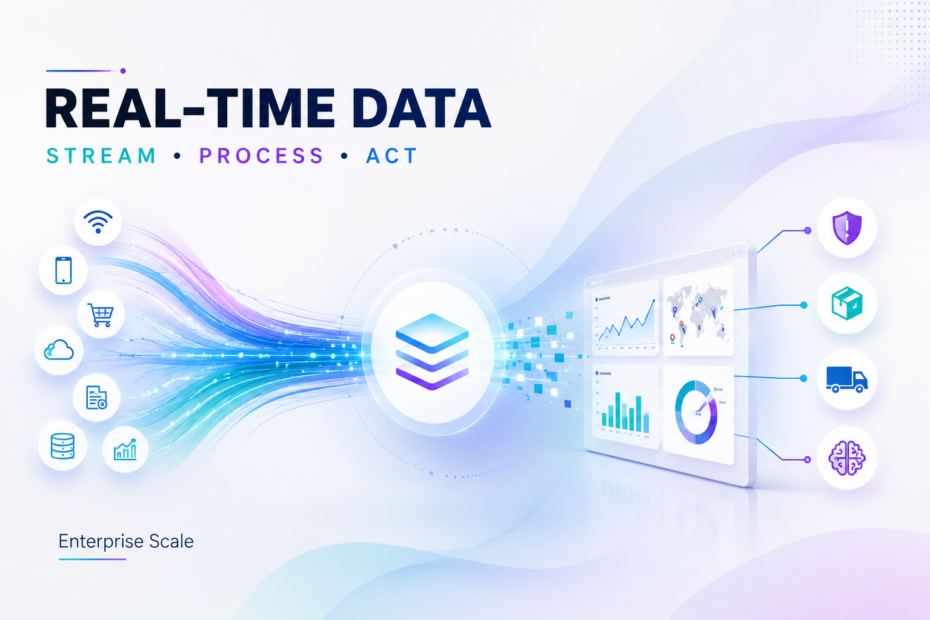
A few years ago, “real-time” in most enterprises meant a dashboard that refreshed every hour and nobody complained because nobody expected better. That bar has moved. Fast.
Today, a fraud team wants to block a suspicious transaction before it clears, not after. A logistics company wants to reroute a truck the moment a shipment is delayed, not the next morning during a stand-up. A retailer wants to update inventory across channels the second a product sells out — not when the nightly batch job finally gets around to it.
The gap between “we have the data” and “we have the data when it actually matters” is where real-time data engineering lives. And for Data Architects and CTOs, closing that gap has quietly become one of the highest-leverage investments on the roadmap.
Why Batch Processing Is Running Out of Runway
Batch pipelines aren’t going away — plenty of workloads genuinely don’t need sub-second freshness. But batch has a structural problem: it forces a trade-off between cost and currency. Run it hourly and you’re always a little stale. Run it every few minutes and you’re paying for infrastructure that’s mostly idle between runs, plus you’re still bound by however long the job takes to finish.
Streaming architectures sidestep that trade-off entirely. Instead of asking “how often should we look at the data,” they ask “what should happen the instant the data arrives.” That’s a fundamentally different mental model, and it’s why most real-time initiatives fail when teams simply try to run their existing batch jobs more frequently instead of rethinking the pipeline itself.
The Core Architecture Pattern
Most enterprise-grade real-time systems, regardless of industry, tend to converge on the same skeleton:
1. Ingestion Layer
Events (clicks, sensor readings, transactions, logs) are captured the moment they’re generated, typically through a distributed event streaming platform like Apache Kafka, Amazon Kinesis, or Google Pub/Sub.
2. Stream Processing Layer
Tools like Apache Flink, Kafka Streams, or Spark Structured Streaming transform, enrich, aggregate, and filter events as they move through the pipeline, rather than waiting for them to land somewhere first.
3. Serving Layer
Processed data lands in low-latency stores (Redis, Apache Druid, ClickHouse, or a real-time-optimized data warehouse) that applications and dashboards can query without waiting on a batch refresh.
4. Action Layer
This is the part teams most often forget. Real-time data that nobody acts on in real time is just an expensive way to look at old problems faster. The pipeline needs to trigger something — an alert, an API call, a model inference — not just populate a chart.
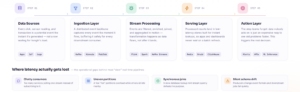
A useful way to picture this: instead of one long conveyor belt that dumps data into a warehouse at the end, think of it as a relay race, where each stage hands off a lighter, more refined version of the data to the next — and every handoff happens in milliseconds, not hours.
Where Latency Actually Gets Lost
CTOs are often surprised to learn that raw processing speed is rarely the bottleneck. Latency tends to creep in through:
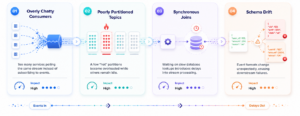
- Overly chatty consumers — too many services polling the same stream instead of subscribing to it
- Poorly partitioned topics — a handful of “hot” partitions get overloaded while others sit idle
- Synchronous joins across systems — waiting on a slow database lookup mid-stream defeats the purpose
- Schema drift — producers changing event formats without warning, causing silent processing failures downstream
None of these are exotic problems. They’re operational discipline problems, and they’re exactly why real-time architecture needs architects, not just engineers wiring tools together.
Getting the Foundations Right Before Scaling
A pattern we see repeatedly with enterprise clients: teams jump straight to “we need Kafka and Flink” before answering three quieter questions that determine whether the investment actually pays off.
What decision changes if this data arrives in 2 seconds instead of 2 hours?
If the honest answer is “none,” that data doesn’t need a real-time pipeline — and building one anyway just adds operational cost.
Who owns data quality at the point of ingestion?
Real-time systems amplify bad data faster than batch systems do. A malformed event doesn’t wait in a queue to be caught during a nightly QA run; it flows straight into a decision.
Can the organization actually act on the data fast enough to matter?
Streaming analytics that feed into a weekly review meeting aren’t real-time — they’re expensive batch analytics with better marketing.
Getting these right upfront is what separates architecture from assembly.
Bringing It Together
Real-time data engineering isn’t a single tool or a single team’s project — it’s an architectural discipline that touches ingestion, processing, storage, and the business processes that consume the output. Enterprises that treat it as infrastructure alone tend to end up with fast pipelines feeding slow decisions. The ones that treat it as an end-to-end capability — connecting Kafka clusters to real business triggers — are the ones actually shortening the distance between “something happened” and “we did something about it.”
That distance is, ultimately, the whole point.
Conclusion
As enterprises continue to accelerate digital transformation initiatives, the value of data is increasingly determined by how quickly it can be transformed into action. Real-time data engineering enables organizations to move beyond retrospective reporting and toward proactive, event-driven decision-making that delivers measurable business impact.
However, success requires more than deploying streaming technologies. Effective real-time architectures are built on clear business objectives, strong data governance, scalable processing frameworks, and the ability to operationalize insights the moment they are generated. Organizations that align these elements can reduce latency, improve operational efficiency, enhance customer experiences, and respond to changing conditions with greater agility.
Ultimately, the goal of real-time data engineering is not simply to process data faster—it’s to shorten the gap between an event occurring and a meaningful business response. Enterprises that master this capability will be better positioned to compete in an environment where speed, accuracy, and responsiveness have become critical differentiators.
Frequently Asked Questions
What’s the difference between real-time and near-real-time data processing?
Real-time processing typically occurs within milliseconds to a few seconds of an event being generated. Near-real-time processing allows for a slight delay, often ranging from seconds to a few minutes, which is sufficient for many business applications while requiring less infrastructure complexity.
Is Apache Kafka mandatory for a real-time data architecture?
No. While Apache Kafka is one of the most widely adopted event-streaming platforms, alternatives such as Amazon Kinesis, Google Pub/Sub, Apache Pulsar, and Azure Event Hubs can also support real-time data architectures. The best choice depends on business requirements, cloud strategy, and technical expertise.
How do enterprises manage data quality in streaming pipelines?
Organizations typically implement schema registries, real-time validation rules, event monitoring, and dead-letter queues to identify and isolate malformed data before it affects downstream systems and business processes.
What’s a realistic first use case for a company new to real-time data engineering?
Strong initial use cases include fraud detection, inventory synchronization, operational alerting, and customer engagement triggers because they have clear business outcomes that benefit directly from faster decision-making.
How does real-time architecture affect infrastructure costs?
Streaming infrastructure runs continuously rather than on scheduled intervals, making costs more predictable but requiring careful planning. Organizations typically optimize spending through partition management, autoscaling, and tiered storage strategies.